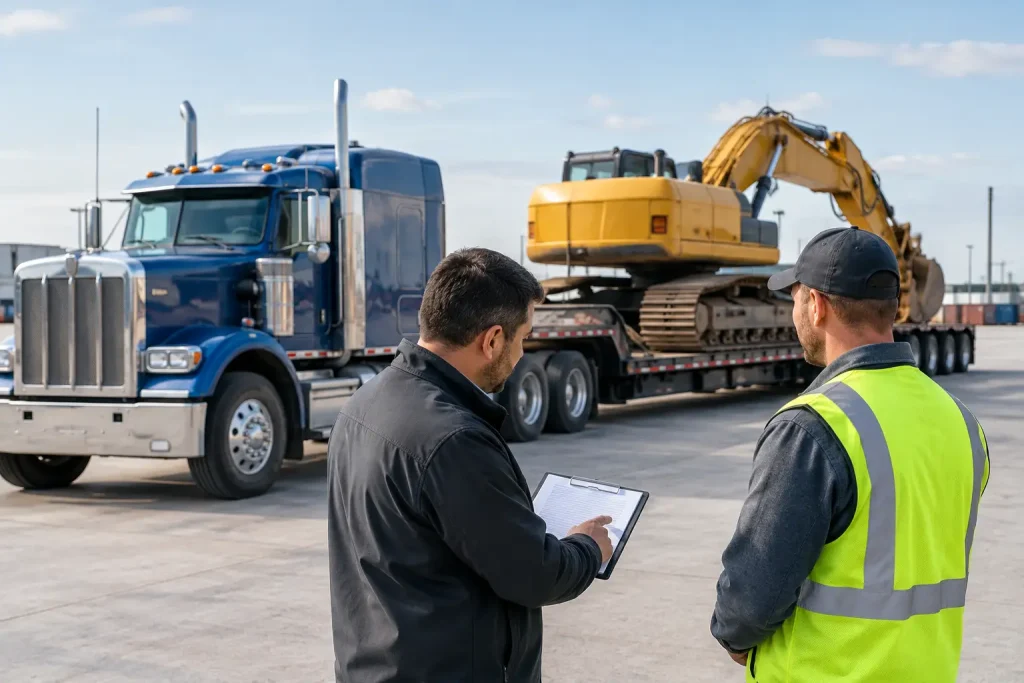
A freight broker vs carrier decision affects far more than who answers the phone when you need a flatbed. For machinery, construction equipment, steel, agricultural equipment, and other open-deck freight, the right arrangement can shape trailer selection, pickup feasibility, route planning, permit coordination, and the information available when conditions change.
A broker and a carrier have different jobs. Neither is automatically the better choice for every shipment. The practical question is which setup gives your load the right equipment, capacity, communication, and operational support for its specific requirements.
Freight Broker vs Carrier: The Core Difference
A freight carrier is the trucking company that physically transports the freight. The carrier employs or contracts with the driver, provides the truck and trailer, operates under its own U.S. Department of Transportation and motor carrier authority as applicable, and performs the pickup, transport, and delivery.
A freight broker arranges transportation between the shipper and a qualified carrier. The broker does not haul the load unless it is also separately registered as a motor carrier. A brokerage’s role is to understand the shipment, identify suitable carrier options, coordinate the movement, communicate with the parties involved, and help manage the details before and during transit.
For a standard pallet shipment, the distinction may feel minor. For a large excavator needing a specialized trailer, a site with limited access, and permits across several states, the difference becomes much more visible. The shipper needs a workable plan before a truck is dispatched.
What the Carrier Is Responsible For
The carrier is responsible for the transportation operation. That includes supplying a properly equipped truck and trailer, assigning a qualified driver, inspecting the equipment, and conducting the actual pickup and delivery.
For open-deck freight, the carrier also assesses whether the load can be safely and legally loaded onto the assigned trailer. A flatbed may work for freight that stays within height limits and can be loaded by crane or forklift. A step deck provides a lower deck height for taller machinery. A lowboy provides a lower deck for suitable heavy or tall equipment. An RGN is a type of lowboy with a removable gooseneck that allows front loading; other trailers may use different loading arrangements. Confirm the actual deck height, capacity and loading method with the carrier.
The driver is not usually the loading operator. Your facility, jobsite, dealer, auction yard, or designated loading contractor must provide appropriate loading equipment and personnel unless other arrangements are confirmed in advance. The carrier and driver need accurate dimensions, weight, loading method, and site conditions early enough to determine whether the planned equipment can safely access and load the freight.
Carriers must comply with applicable federal and state rules. For interstate commercial motor vehicles, the Federal Motor Carrier Safety Administration regulates safety requirements, including hours-of-service rules and applicable operating authority requirements. FMCSA cargo securement rules include 49 CFR Part 393, Subpart I. Securement methods depend on the commodity, trailer, load characteristics, and applicable rules, so shippers should not assume that a generic chain count or tie-down approach applies to every machine.
What the Freight Broker Does
A broker turns shipment details into a carrier-ready plan. That begins with asking questions that often determine whether a quote is useful or merely a rough estimate.
For example, a broker may help confirm whether a machine’s stated height includes an exhaust stack, cab, boom position, or removable attachment. They may identify that the quoted weight excludes an attachment, counterweight, bucket, or fluids. They may also flag that a trailer needs enough deck length to accommodate an overhang or that a jobsite requires a driver to approach from a particular direction.
For oversize or overweight movements, a broker may coordinate with carriers and permit service providers regarding route restrictions, permit needs, escort requirements, and timing. State authorities issue oversize and overweight permits; requirements can vary by route, axle configuration, dimensions, and roadway conditions. A load that is legal in one state may need permits or a different route in another.
The broker also provides a central communication point between the shipper, carrier, loading location, receiver, and any involved site contacts. This can be particularly useful when a shipment has multiple moving parts: an auction release, a construction-site appointment, a crane schedule, restricted gate hours, or equipment that must be cleaned before transport.
A broker cannot replace the carrier’s operational judgment or the driver’s safety decisions. If site access is unsafe, the load differs from the description, or weather and road restrictions affect the trip, plans may need to change.
When Working Directly With a Carrier Makes Sense
Working directly with a carrier can be a good fit when you have repeat freight on predictable lanes, know the equipment needed, and have an established relationship with a carrier that routinely serves your locations.
It can also work well when the carrier has the exact specialized trailer and regional familiarity required for a particular movement. A contractor moving similar equipment between recurring jobsites, for instance, may value direct coordination with a carrier that already understands its loading process and operating hours.
The trade-off is capacity. A single carrier has its own trucks, drivers, trailer types, and service area. If its equipment is committed, out of position, or unsuitable for an unusual load, you may need to start looking elsewhere. That is not a failure on the carrier’s part. It is simply a limit of operating a finite fleet.
When a Freight Broker May Be the Better Fit
A broker can be particularly useful when the shipment is specialized, time-sensitive without requiring a promised delivery time, or difficult to match with the right equipment. Examples include a machine that needs an RGN, an oversized industrial component, a multi-piece project movement, or freight moving between locations where carrier availability changes quickly.
Because a brokerage can coordinate with multiple independent carriers, it may have more flexibility to search for a trailer type, pickup position, or carrier experience that fits the load. That does not mean every load will have immediate capacity or identical pricing. Specialized equipment availability, fuel costs, permit requirements, route conditions, and loading complexity all influence the options.
For first-time shippers, a broker can also help organize the information a carrier needs before dispatch. Fargo Express coordinates nationwide domestic open-deck and oversized transportation with independent carriers, with a focus on practical planning rather than generic equipment labels.
Information Both a Broker and Carrier Need
Whether you work with a broker, a carrier, or both, complete shipment details improve the quality of the transportation plan. Gather the facts before requesting a quote:
- Pickup and delivery addresses, plus site contact names and phone numbers
- Freight description, make, model, and current condition
- Exact length, width, height, and total weight, including attachments
- Whether the freight is operable and how it will be loaded and unloaded
- Photos from all sides, plus close-ups of protrusions or removable parts
- Pickup and receiving hours, appointment rules, gate restrictions, and site access details
- Any known permit, escort, route, or jobsite timing constraints
Photos are often as valuable as measurements. They can reveal low clearance concerns, loose components, loading ramps, attachment positions, or access challenges that a written description misses.
Questions to Ask Before You Book
A practical conversation should clarify who is doing what. Ask whether the proposed trailer type is based on your actual dimensions and loading method. Confirm who will provide loading and unloading equipment, whether the locations can accommodate the truck, and what information the driver will receive before arrival.
For oversize freight, ask how permits and route restrictions will be addressed and whether the pickup date depends on permit approval. Do not assume a permit is automatic or that one route will work in all conditions. State agencies issue permits under their own rules, and restrictions can change because of construction, weather, bridge limitations, or local requirements.
You should also confirm communication expectations. Ask who will contact the pickup and delivery locations, how status updates are handled, and whom to call if the machine is not ready or the jobsite changes. Clear roles reduce avoidable delays.
The Best Choice Depends on the Shipment
The freight broker vs carrier question is not really about choosing a winner. A carrier performs the transportation. A broker helps arrange and coordinate it. For a simple repeat shipment, direct carrier service may be the most efficient path. For a specialized, oversized, or hard-to-cover load, a broker may add value by matching the freight to an appropriate independent carrier and helping organize the operational details.
Before you request transportation, measure the freight where it sits, photograph it honestly, and confirm who can load it. Those few steps give any qualified carrier or broker a far better chance of building a shipment plan that works when the truck reaches your site.
Discuss Your Open-Deck Shipment
For interstate freight or oversized equipment transportation, share the shipping dimensions, verified weight, locations and loading arrangements. Request a freight quote so Fargo Express can review your needs with independent carriers.