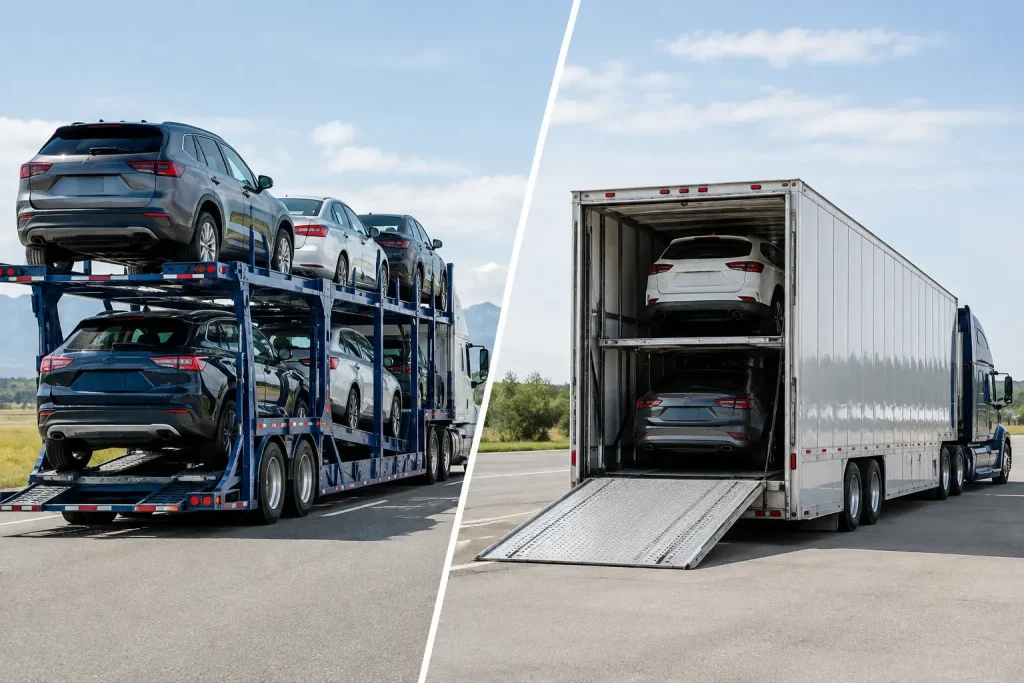
A cross-country move, a collector-car purchase, or a dealership transfer can all start with the same question: open vs enclosed car hauling. The right answer is not automatically “enclosed for expensive cars” or “open for everything else.” It depends on the vehicle’s condition and value, how much exposure you are comfortable with, the pickup and delivery locations, timing flexibility, and the type of carrier equipment available for the lane.
Open transport can be a practical choice for running passenger vehicles. Enclosed transport adds a physical barrier from weather and road debris, but it commonly costs more and may have different scheduling constraints. Knowing what each service actually involves helps you request a quote that matches the vehicle and avoids surprises at pickup.
What open car hauling involves
Open car hauling uses an open trailer, often a multi-vehicle carrier that may transport several cars, SUVs, or light trucks at once. It is the type of equipment commonly seen delivering new vehicles to dealerships. The vehicle is secured on the trailer but remains exposed to normal highway conditions.
For a daily driver, a standard dealership transfer, an auction vehicle that is ready for pickup, or a family vehicle moving with its owner, open transport is often the practical option. It generally offers more carrier availability because open auto carriers serve a broad range of domestic routes.
Exposure is the trade-off. The vehicle can encounter rain, dust, road spray, and debris during transit. That does not mean damage is expected, but it does mean an open shipment is not the same as storing a vehicle inside a covered trailer. A wash after delivery is common, particularly on long routes or during winter weather.
Open trailers also vary. A vehicle may be loaded on an upper or lower deck, and some carriers use equipment with ramps and loading angles that matter for low-clearance cars. If your vehicle has a lowered suspension, front splitter, extended body kit, wide tires, or other modifications, disclose that before booking. The coordinator needs accurate information to match the shipment with appropriate equipment and discuss whether the load can be handled safely.
When enclosed car hauling makes sense
Enclosed car hauling places the vehicle inside a covered trailer. That added enclosure reduces exposure to weather, road grime, and loose debris from traffic. It is often requested for collector vehicles, exotic or luxury cars, restored classics, race vehicles, prototype vehicles, and cars with specialty finishes or low ground clearance.
The value of enclosed service is not limited to a vehicle’s market price. A recently restored vehicle may be difficult to replace. A car traveling to a show or event may need to arrive clean and protected from weather. A buyer who has never seen an auction purchase in person may prefer the additional protection while moving it home for inspection.
Ask which ramp or lift system the assigned carrier will use for a low-clearance vehicle; the word “enclosed” alone does not establish loading clearance. Provide the lowest ground-clearance point, any non-factory modifications, and whether the vehicle can be driven normally. If it cannot start, steer, roll, or brake, say so when requesting a quote. Non-running vehicles require advance planning and may need specific loading equipment.
Enclosed capacity can be more limited on certain routes. A carrier may be moving fewer vehicles than an open multi-car trailer, and not every market has the same volume of enclosed freight. That can affect price, pickup windows, and the amount of flexibility needed from the shipper.
Open vs. enclosed car hauling: the practical differences
The choice comes down to protection, budget, equipment fit, and scheduling rather than a simple good-better hierarchy.
Protection from the road
An enclosed trailer reduces direct exposure to rain, snow, sun, road spray, and debris; it is not a promise of damage-free transport. It is a sensible option when preserving a vehicle’s presentation matters as much as getting it from point A to point B.
Open transport exposes the vehicle to ordinary outdoor travel conditions. For many standard vehicles, that is an acceptable and cost-conscious trade-off. The vehicle should still be inspected carefully at pickup and delivery.
A covered trailer still needs suitable loading and securement. The assigned carrier must assess the vehicle, trailer and securement system under applicable FMCSA cargo securement rules. Loading clearance and securement points should follow the relevant equipment and vehicle manufacturer instructions.
Cost and carrier availability
Open transport is commonly less expensive because carriers can typically move more vehicles on one trailer and serve more lanes. Enclosed service often has a higher transportation cost due to the equipment, capacity, and specialized nature of the shipment.
A quote should be based on the actual vehicle, route, operating condition, and requested service level. Be cautious with any estimate that is given without asking whether the vehicle runs, how low it sits, or whether either location has room for a large truck. Those details can materially change carrier options.
Vehicle type and condition
Most stock sedans, SUVs, pickup trucks, and daily drivers fit naturally on open transport. Enclosed hauling is often worth considering for vehicles with high collectible value, custom paint, delicate finishes, rare parts, or very low clearance.
Condition matters just as much as model year. A newer luxury sedan that is used daily may be a good open-transport candidate. A modestly priced but freshly restored classic may justify enclosed service. There is no universal threshold based on a vehicle’s price alone. Confirm the assigned carrier’s written cargo-coverage limits, deductibles and exclusions for your vehicle; an enclosed trailer does not itself establish coverage for its full value.
Pickup and delivery access
Neither open nor enclosed transport guarantees driveway service. Full-size car-hauling equipment needs adequate turning room, overhead clearance, and a safe place to load. Narrow residential streets, low-hanging branches, apartment complexes, gated communities, and busy urban blocks may require a nearby meeting location.
Enclosed trailers can have their own access limitations because of their size and configuration. Before a carrier is assigned, confirm whether the pickup and delivery locations can accommodate a large truck. A nearby wide street, shopping center lot, or other agreed meeting point may be more practical, provided it is safe and permitted.
Information to provide for an accurate quote
A useful auto transport request starts with complete facts. As FMCSA explains for automobile transport customers, a broker arranges transportation while the motor carrier performs the haul. The more clearly a broker can present the shipment to independent carriers, the better the carrier can assess whether the vehicle and locations fit its equipment.
Include these details when comparing open and enclosed options:
- Pickup and delivery cities, ZIP codes, and any location-access restrictions.
- Vehicle year, make, model, and whether it runs, steers, rolls, and brakes.
- Ground clearance, modifications, oversized tires, roof racks, or other details that affect loading.
- Earliest pickup date, preferred delivery timing, and how much date flexibility you have.
- Whether the vehicle is already released by a dealer, auction, seller, storage facility, or other party.
- The name and phone number of the person who can meet the carrier at each end.
Auction buyers should verify release status before scheduling. A vehicle can be paid for but still unavailable for pickup because of auction paperwork, storage procedures, limited pickup hours, or a required release number. A carrier arriving before release is confirmed can create avoidable delays and extra coordination.
Prepare the vehicle for either service
Before pickup, remove personal items. Discuss any exception with the assigned carrier in advance and confirm the written terms rather than assuming belongings can travel with the vehicle. Confirm the assigned carrier’s fuel or battery-charge instructions and the vehicle manufacturer’s transport guidance before pickup, keeping enough energy for the agreed loading and unloading procedure. Secure or remove loose exterior accessories when practical, and make sure the driver can access the keys.
Document the vehicle’s condition before loading. Take clear, dated photos from all sides, including close-ups of existing scratches, dents, cracked glass, wheel damage, and low body panels. At pickup, review the carrier’s inspection report carefully before signing it. Repeat the process at delivery before final acceptance.
This inspection process matters for open and enclosed shipments alike. Enclosed transport reduces exposure, but it does not eliminate the need for accurate condition records. If you notice a concern at delivery, note it on the delivery inspection paperwork before the carrier leaves and follow the stated claims procedure promptly.
Choose protection that matches the shipment
For most ordinary vehicles, open hauling is a practical way to move a car across the United States. For collectible, exotic, restored, low-clearance, or presentation-sensitive vehicles, enclosed hauling may justify the additional cost and narrower equipment availability.
The best choice is the one that reflects the vehicle, route, location access, and your tolerance for normal road exposure. Fargo Express is a U.S. freight broker that coordinates vehicle transportation with independent motor carriers when the shipment details are ready. Start with the facts, ask how the proposed equipment fits your vehicle, and leave enough flexibility for a carrier to complete the move safely.
Ready to compare suitable options? Request a vehicle shipping quote with your vehicle, route, condition and pickup dates.