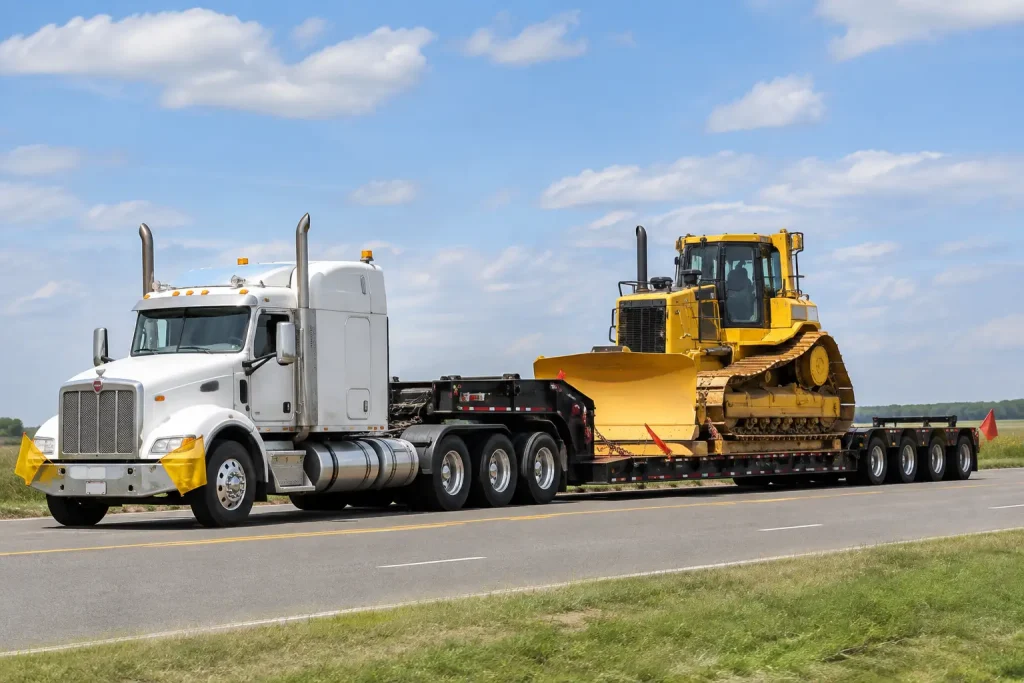
A machine can fit on the right trailer and still be unable to move on the planned date. Oversize load permit requirements are driven by the shipment’s actual dimensions, axle weights, origin and destination, and the roads available between them. A few inches of height, a wider attachment, or a different loading position can change the route, permit cost, escort needs, and pickup plan.
For commercial shippers moving construction equipment, industrial machinery, agricultural equipment, or other open-deck freight, permits should be part of the shipment plan from the first quote request. They are not paperwork to sort out after a truck arrives.
What makes a load oversized or overweight?
An oversized load exceeds a state’s legal dimensional limits for travel without a permit. An overweight load exceeds an applicable gross, axle, or bridge-weight limit. A shipment can be oversized, overweight, or both. Each condition can trigger different routing and permit requirements.
On the National Network, federal law generally allows commercial vehicles up to 102 inches wide, or 8 feet 6 inches, on designated interstate and qualifying routes. Federal law does not establish one nationwide maximum height, and states set many operating limits. The commonly discussed 80,000-pound federal gross vehicle weight limit on Interstate highways is also not a blanket approval for every combination or road. Axle spacing, axle group weights, bridge formulas, local restrictions, and state rules still matter. See the FHWA vehicle size and weight guidance and federal weight and permit overview.
That is why a 12-foot-wide excavator and a 12-foot-wide crated machine may require different planning. Their trailer configuration, total axle weights, loading height, center of gravity, and ability to remove attachments can all affect the permit application.
Oversize load permit requirements vary by state and route
There is no single U.S. oversize permit that covers an interstate shipment. States issue permits for travel within their borders, and a route crossing several states usually needs separate permits for each state. Local agencies may also control county roads, city streets, port facilities, or roads leading to a jobsite.
Permit eligibility also matters. Authorities may require the load to be nondivisible or non-reducible; a permit is not automatically available for every oversized or overweight configuration. For example, Caltrans permit guidance explains its non-reducible-load criterion. Confirm eligibility with the carrier or permit specialist before planning the move.
Permit conditions depend on the jurisdiction and permit type. A single-trip permit may identify approved highways, travel dates, hours of operation, required warning signs, flags, lighting, pilot cars, or other conditions. It can also restrict travel through metropolitan areas during peak traffic, on holidays, after dark, or during adverse weather.
States often use threshold dimensions to determine when escorts or special reviews apply, but those thresholds are not uniform. One state may allow a given width with signs and flags while the next requires one or more pilot vehicles. Very tall loads need particular attention because bridge clearances, utility lines, traffic signals, and railroad crossings may limit the available route.
Check the actual issuing authority’s conditions, such as Caltrans single-trip permit guidance. Do not assume that a permit obtained for a previous shipment will apply again. A changed route, a different trailer, seasonal road restrictions, construction work, or a revised load measurement can make the prior plan unusable.
Permit lead time depends on complexity
Straightforward dimensional permits may sometimes be processed quickly, but complex loads can require more time. Overweight moves, superloads, unusual axle configurations, engineering reviews, utility coordination, or local approvals may add days or longer. Permit offices can also have reduced processing around holidays, weather events, and seasonal restrictions.
The practical lesson is simple: provide shipment details early and avoid treating a requested pickup date as a guaranteed permit date. The carrier cannot legally begin the permitted portion of the move until required permits are in hand and their conditions can be met.
Information needed before permits can be requested
Accurate measurements are the foundation of a usable permit plan. Estimates based on a brochure or a similar model are a starting point, not a final answer. Dimensions should reflect the equipment as it will travel, including attachments, counterweights, crates, exhaust stacks, tires, and any overhang.
For an informed quote and permit review, have these details ready:
- Overall loaded length, width, height, and weight
- Equipment make, model, serial number when available, and a clear description of attachments
- Whether attachments, buckets, booms, tracks, wheels, counterweights, or other components can be removed
- Pickup and delivery addresses, including jobsite entrances and preferred access roads
- Loading and unloading method, site contact information, and available appointment windows
- Photos showing the equipment from several sides, plus any known clearance or access limitations
For overweight freight, axle weights and axle spacing are especially important. The final permit calculation depends on the entire vehicle and load combination, not just the machine’s listed operating weight. A carrier may need to determine whether a flatbed, step deck, lowboy, or RGN configuration can distribute weight appropriately while keeping the load within practical height limits.
Measure loaded height, not equipment height alone
A frequent planning error is using the manufacturer’s overall height without adding deck height. A lower deck can reduce loaded height, but the actual trailer geometry and available clearances must be checked for the selected equipment. Conversely, selecting a lower trailer can create separate issues involving ground clearance, loading ramps, turning room, or route suitability.
The carrier determines the specific equipment configuration and securement method. The shipper should provide correct cargo information and disclose modifications, loose components, or loading constraints before dispatch.
Route surveys, escorts, and operating restrictions
A route is more than a line between two ZIP codes. Permitting authorities evaluate whether the roads and structures can accommodate the specific dimensions and weights requested. For larger or more complicated shipments, a route survey may be needed to verify vertical clearances, turning radii, bridge capacity, railroad crossing conditions, and obstacles such as overhead lines.
Pilot cars, also called escorts, may be required ahead of or behind the load. Their role is to help warn road users, communicate with the truck driver, and assist with safe movement under permit conditions. Escort requirements can change at state lines and may depend on width, length, height, overhang, road type, or time of travel.
Some moves also require specific signage, flags, amber warning lights, or lighting. These requirements belong to the permitted carrier operation, not to the shipper’s improvised preparation. The Federal Motor Carrier Safety Administration’s cargo securement rules in 49 CFR Part 393 set baseline federal requirements, while state permits add route and travel conditions.
Who handles each part of the permit process?
The shipper’s role is to provide complete, accurate cargo and site details, confirm readiness for loading, and alert the transportation coordinator to access constraints. If the load is not measured correctly or differs from the description at pickup, the permit plan may need to be revised.
The freight broker coordinates the transportation plan with an independent carrier, gathers information needed for quoting, and helps align trailer selection, timing, and permit considerations. A broker does not issue state permits or operate the truck.
The carrier is responsible for operating legally under applicable regulations and permit conditions. Depending on the move, the carrier or a qualified permit service obtains permits, confirms routing, arranges required escorts, and selects the tractor-trailer configuration. The loading operator is responsible for safely loading the equipment according to site procedures and coordinating with the driver on practical loading conditions.
Clear responsibilities prevent a common problem: a truck arrives, but the load cannot be loaded in the configuration used for the permit. For example, an attachment may remain installed, a crane may not be available, or the equipment may be positioned where the trailer cannot access it.
Avoid permit problems before the truck is dispatched
The best time to solve access and dimension issues is before the carrier is assigned. Confirm whether the pickup site has turning room for the planned trailer, firm ground for loading, and safe clearance from gates, trees, structures, or power lines. At delivery, check whether the receiving site can accept the equipment during permitted travel hours and whether unloading equipment will be ready.
If the equipment can be partially disassembled, discuss that option early. Removing an attachment can reduce width or height, but it also adds labor, handling, packaging, and reassembly considerations. The lowest permit category is not automatically the lowest total shipping cost.
For particularly large equipment, use conservative timing. A route may need to avoid weekends, nighttime hours, certain city corridors, or temporary construction zones. Changes made after permits are issued can mean new permits, revised escorts, or a delayed departure.
Start with the dimensions that will actually travel
Reliable permit planning starts with a realistic description of the load, not the shortest possible specification sheet. Share photos, loaded dimensions, weight information, and site details when requesting an oversized freight quote. Fargo Express can help coordinate a practical plan with an independent carrier, including the trailer type and permit considerations that fit the shipment.
A careful review before dispatch gives the carrier the information needed to pursue the right permits and gives your team a better chance of having the right equipment, access, and schedule in place when the truck arrives.
For open-deck freight that stays within the applicable legal limits, explore our Interstate Ground Delivery service. The carrier still needs to review the actual cargo, equipment, and route before dispatch.