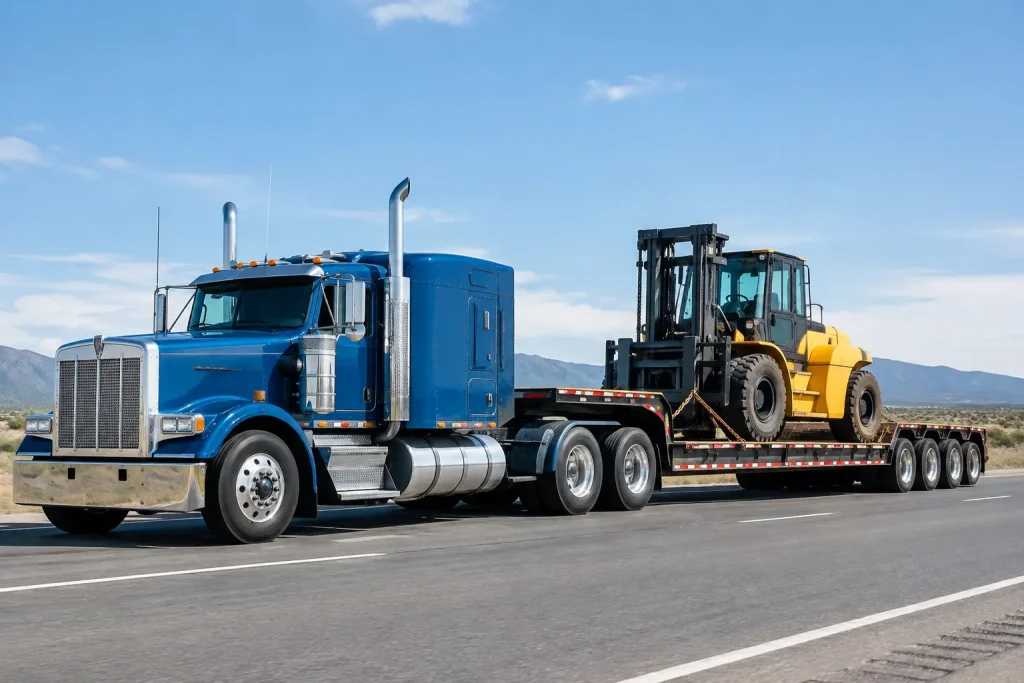
A forklift that fits comfortably inside a warehouse can become a challenging open-deck load once it needs to travel several states. Mast height, attachment width, tire condition, loading access, and the actual operating weight all affect the trailer choice and the shipment plan. Forklift shipping across states goes more smoothly when those details are collected before a carrier is assigned, not when the truck reaches the pickup site.
This guide is for commercial shippers moving forklifts between branches, jobsites, dealerships, auctions, warehouses, rental yards, or customer locations. The goal is not simply to find available capacity. It is to coordinate a load that can be safely loaded, legally routed, and received without unnecessary delays.
Start With the Forklift’s Actual Transport Dimensions
The data plate, manufacturer specifications, and equipment manual are useful starting points, but confirm the dimensions of the forklift as it will be loaded. Attachments, extended forks, side-shifters, cab guards, and mast position can change the profile substantially.
Provide the coordinator with the overall length, width, height, and complete transport weight in pounds. Rated lifting capacity is not the forklift’s own shipping weight. Confirm whether a published figure includes the battery, fuel, and installed attachments. Toyota’s data-plate guidance, for example, distinguishes truck weight from battery weight on certain electric models. Include fork extensions and any separately shipped pieces in the load details.
Measure the forklift in the transport position specified by its manufacturer, including the highest point of the lowered mast, overhead guard, or cab. An upright mast can be the deciding factor between a standard flatbed and a lower-deck trailer. Equipment that is close to a legal height limit should be measured carefully rather than estimated from a brochure.
Clear, current photos are equally valuable. Send photos from each side, the front, the rear, the mast, the tires, and the pickup area. They help a freight coordinator and carrier identify clearance concerns, loading direction, attachment overhang, and whether the forklift appears able to drive onto a trailer.
Choose the Trailer Around the Load and the Site
A single warehouse forklift may move on a standard 48-foot or 53-foot flatbed when its height and weight permit. That is not an automatic answer, though. The loading site and delivery site matter as much as the machine itself.
A step deck lowers the main deck relative to a standard flatbed and can be a practical choice for a taller forklift. An RGN or lowboy may be appropriate for a taller or heavier machine or a site without a suitable dock. Confirm the available trailer’s actual deck height, capacity, and ground-loading arrangements with the carrier. The right option depends on the machine dimensions, carrier equipment availability, route, and whether the forklift can safely be driven or placed onto the trailer.
Avoid selecting a trailer solely because it has the lowest rate. A trailer that cannot enter a tight industrial yard, clear an overhead obstacle, or be loaded with the available ramp or dock setup can turn a routine move into a missed pickup.
When loading method changes the plan
Confirm how the forklift will get onto and off the trailer. A shipping dock may support loading onto a flatbed, while a ground-level site may require a trailer with suitable loading access or onsite lifting equipment. If a crane, forklift, dock, or loading crew is needed, identify who is providing it and when it will be available.
The shipper is responsible for accurately describing the equipment and the site. The carrier supplies the truck and trailer and performs transportation. The loading operator controls the loading equipment and site process. A freight broker such as Fargo Express helps coordinate information among those parties, but should not be assumed to be the carrier or the onsite loading crew.
Account for Interstate Height, Weight, and Permit Issues
Do not assume a forklift shipment is within standard legal limits. A tall mast, wide attachment, or heavy-capacity forklift can create an oversize or overweight condition depending on the loaded dimensions, axle distribution, and route.
Federal length and width rules apply on the National Network, while federal weight limits apply on the Interstate System, subject to applicable exceptions. There is no federal vehicle-height limit; states set height limits. See the FHWA size and weight guidance. States administer oversize and overweight permits, with route-specific conditions. For example, Caltrans single-trip permits depend on the permitted route and its clearances. Permit requirements, escort needs, travel-hour limits, and bridge restrictions must be checked for each jurisdiction on the planned route.
Cargo securement is also regulated. For interstate motor carriers, the applicable federal requirements are found in 49 CFR Part 393, Subpart I. The carrier must determine the proper securement method and equipment for the specific forklift and trailer. The shipper should provide accurate weight, dimensions, condition information, and any manufacturer transport instructions, rather than trying to prescribe a tie-down arrangement.
If the unit is near legal limits, disclose that early. Late dimension changes can mean a different trailer, a permit review, a revised route, or a rescheduled pickup.
Prepare the Forklift Before Pickup
A forklift should be ready at the agreed pickup window, with a responsible site contact available to answer questions. Follow the operator and transport instructions for the exact make and model, and arrange trained, authorized personnel for loading. Confirm preparation with the carrier before pickup.
Before pickup, make sure the machine is accessible and can be moved as represented. Remove loose items from the cab or operator area, identify any detachable accessories, and disclose mechanical issues such as inoperative brakes, steering problems, leaks, flat tires, or a mast that will not lower. A non-running forklift is not necessarily unshippable, but it changes the loading requirements and must be arranged in advance.
If the forklift has a propane cylinder, battery system, fuel system, or other potentially regulated component, tell the coordinator what is installed. Carrier policies and applicable hazardous-material rules may affect the transportation plan. Do not assume a standard equipment shipment has no special handling considerations.
Document the forklift’s condition before it leaves. Dated photos and a written condition record can be useful for both the pickup and delivery teams. Record visible dents, broken lights, worn tires, attachment condition, and any existing hydraulic seepage. This is good operating practice, especially for used equipment sold through an auction or transferred between facilities.
Plan the Pickup and Delivery Sites, Not Just the Mileage
Interstate distance affects transit planning, but site conditions often cause more disruption than highway miles. A tractor-trailer needs enough room to enter, turn, park, load, and exit. Narrow gates, soft ground, overhead wires, parked trailers, and active jobsite traffic can all limit access.
Ask the pickup and receiving contacts these questions before scheduling:
- Can a full-size tractor-trailer enter, turn around, and leave without backing onto a public road?
- Is there a dock, ramp, crane, or qualified operator available at the scheduled time?
- Are there gate appointments, safety orientations, PPE requirements, or site-specific hours?
- Are overhead wires, low awnings, trees, or tight corners present near the loading path?
- Who has authority to release the forklift and sign the delivery paperwork?
For a construction site or an agricultural property, a location pin alone is rarely enough. Provide the best truck entrance, a dispatch contact who knows the site, and any restrictions caused by weather or ground conditions. A loaded open-deck truck may not be able to use the same path as a pickup truck.
Build a Quote Request That Produces a Usable Plan
A useful quote request is more than origin, destination, and a rough machine description. Give the coordinator the complete shipment picture: pickup and delivery ZIP codes, desired date range, forklift make and model, verified dimensions and weight, attachment details, running condition, loading method, and site access notes.
Also state whether the dates are firm or flexible. Flexibility can expand carrier options, while a fixed appointment, auction release date, or jobsite deadline may require a narrower scheduling plan. Neither approach is inherently better. The right choice depends on the cost of delay, site availability, and equipment readiness.
Ask what trailer type is being considered and why. If the load may require permits, ask whether the quoted plan assumes permit processing and what information is still needed to confirm routing. Clear questions at this stage are more useful than broad assurances about timing.
Keep Communication Active Until Delivery
A forklift move can change after dispatch. The pickup site may discover a low clearance, the machine may not start, weather may affect a jobsite, or the delivery crew may need a different appointment. Notify the coordinator promptly when anything changes, including dimensions, attachments, site hours, and machine condition.
Alex Kram’s transportation background includes operating a trucking and freight forwarding company in Europe and driving flatbed and step deck trucks for nearly a million miles on American highways. That practical perspective reinforces a simple point: accurate load information and workable site conditions matter long before a truck arrives.
For a forklift headed across state lines, the strongest shipment plan is built from verified measurements, a trailer matched to the load, and pickup and delivery teams that know exactly what is expected. For help coordinating the move, explore Oversized Transportation and Interstate Ground Delivery, then request a forklift shipping quote with the verified load and site details.