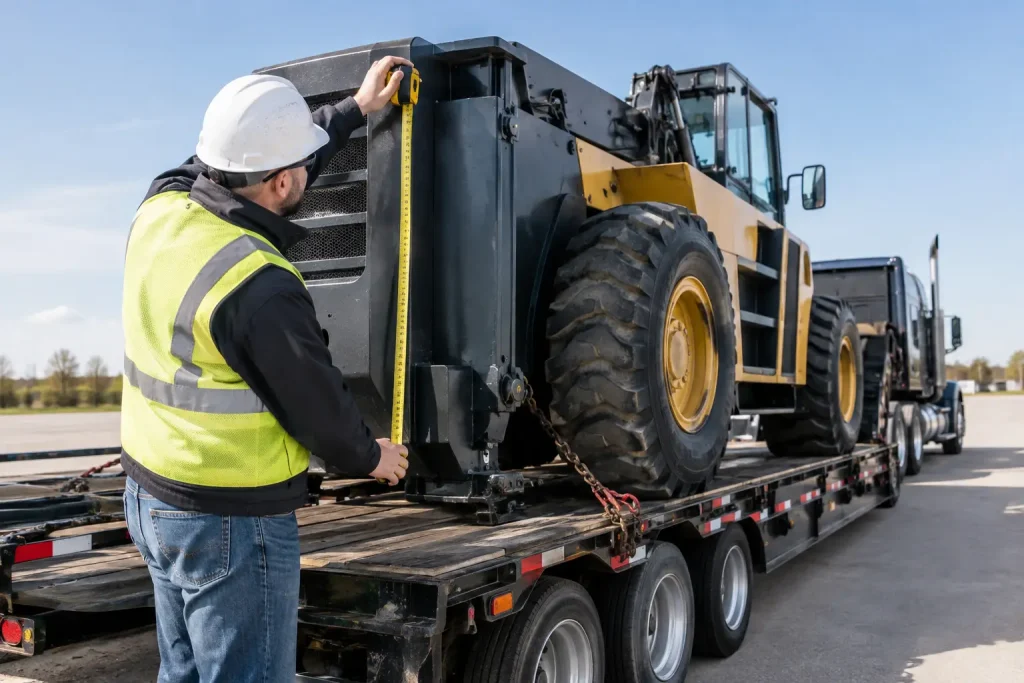
A machine described as “about 10 feet wide” can turn into a costly planning problem if its true transport width is 10 feet 4 inches with attachments installed. That difference can affect trailer selection, route review, permit needs, loading arrangements, and the carrier options available. Knowing how to measure machinery dimensions before requesting a freight quote gives the broker and carrier the information needed to plan the move realistically.
For machinery shipments, measurements are not just specifications from a brochure. They must reflect the machine exactly as it will travel, including buckets, forks, booms, guards, tires, counterweights, and any loose attachments shipped with it. A machine’s operating dimensions are often different from its transport dimensions.
Start With the Machine in Transport Condition
Before taking measurements, decide what will remain on the machine during transit. This is the most important step because removable components can substantially change the shipment’s overall width, height, length, and weight.
A loader may be narrower with its bucket removed. An excavator may need its boom positioned or secured according to the manufacturer’s transport guidance. A tractor with dual tires, a cab, or mounted implements may be much larger than the base model listed online. Do not assume a model number tells the full story.
Confirm whether the machine will travel with attachments installed, detached, or separately loaded. If an attachment comes off, measure it as its own piece and provide its length, width, height, and weight. A detached bucket, blade, grapple, or set of forks still takes trailer space and must be included in the shipment plan.
If the machine has adjustable or folding components, report the dimensions in the position it will actually be transported. A carrier needs the travel configuration, not the smallest possible measurement under ideal conditions.
Machinery Measurements and Shipping Weight
For most machinery moves, the shipper should provide overall length, overall width, overall height, and shipping weight in the actual transport configuration. “Overall” means the farthest outside points of the shipment, not just the main body of the equipment.
Overall length
Measure from the front-most point to the rear-most point. Include a bucket, blade, counterweight, hitch, rear attachment, or any component that extends beyond the machine frame. If an attachment will be removed and loaded separately, list it separately rather than adding it to the machine length.
Length helps determine whether the machine fits on a standard flatbed, step deck, removable gooseneck trailer, or another specialized trailer. It also matters when multiple pieces are traveling together. A load that technically fits by length may still need a different trailer if its weight distribution or loading method is unsuitable.
Overall width
Measure at the widest point, which may be the tires, tracks, axle ends, fenders, handrails, mirrors, a blade, or a mounted attachment. Measure across the outside edges rather than relying on nominal tire or track width.
Width is especially sensitive in oversized freight planning. A few inches can change whether permit review is needed on a particular route. State requirements vary, and a shipment that is acceptable on one route may face restrictions on another due to lane width, construction zones, bridges, or local access roads.
Overall height
For the initial quote, measure from the level ground supporting the machine to its highest overall point in the confirmed transport position, including any protrusions. This is the machine height, not the loaded truck height. Then share anything that may affect loaded height, such as tall tires, a raised cab, exhaust stacks, antennas, or a nonstandard trailer preference.
The total loaded height is measured from the pavement to the highest point of the loaded vehicle or cargo. It depends on the machine, the actual trailer deck height, and any blocking or supports. The carrier must confirm the complete loaded combination. This is why a machine that is manageable on a low deck may be impractical on a standard flatbed. The freight broker coordinates the information, while the carrier evaluates its equipment and route options.
Shipping weight
Provide the machine’s actual weight whenever possible. Use a recent scale ticket that identifies the machine weight, or a manufacturer specification matched to the exact configuration with any differences identified. A published operating weight is not automatically the shipping weight. For example, Caterpillar’s 320 specifications identify a particular boom, stick, bucket, track-shoe and counterweight configuration alongside operating weight; its shipping dimensions are listed separately. Weight changes with attachments, tire ballast, added guarding, fuel, accessories, and modifications.
Do not round a 46,800-pound machine down to 45,000 pounds for a quote. A difference of several thousand pounds can affect axle planning, trailer choice, and whether the carrier can legally carry the load with its available equipment. If the weight is estimated, say so clearly and explain what the estimate includes.
Use the Right Measuring Method
A tape measure is usually sufficient for smaller accessible machinery, but it must be used carefully. Have a qualified operator establish the manufacturer-approved transport position on firm, level ground before measuring. Do not move components simply to obtain a smaller number. Measure from safe positions, keep helpers clear of moving or unsupported parts, and record feet and inches rather than rounding to whole feet. Measure straight horizontal length and width, rather than following curved bodywork or attachments.
For larger equipment, use measuring equipment suitable for the distance and site conditions, following the tool manufacturer’s instructions. Check that the reading spans the intended endpoints and have uncertain measurements verified by a qualified person. Do not substitute a wheel measurement along an uneven path for the machine’s straight overall length.
For a machine that cannot be measured safely, provide the exact make, model, serial number when available, configuration details, and clear photos from each side. Manufacturer data can help establish a starting point, but it should not replace confirmation when the machine has been modified or carries installed accessories.
Take photos that show the full machine from the front, rear and both sides, using safe accessible positions. Do not climb onto the machine or trailer to obtain a photograph or measurement. Also photograph attachments, loading ramps, gate openings, low overhead obstacles, and tight turns at pickup or delivery. Photos do not replace measurements, but they help a coordinator identify questions before a carrier arrives.
Measure Pickup and Delivery Access Too
The machine dimensions are only one part of transportation planning. A trailer must be able to enter, position for loading, and leave safely. A jobsite, farm, yard, plant, or dealership may have a narrow gate or a driveway that works for local equipment but not for a long combination vehicle.
Measure gate width and overhead clearance where access is limited. Note sharp turns, soft ground, steep grades, power lines, parked vehicles, railroad crossings, and construction activity. If loading will happen on a public street, verify whether local restrictions, parking limitations, or permits apply.
Also identify who will load and unload the machinery. The shipper or site operator is generally responsible for ensuring the machine is available, accessible, and ready for loading unless other arrangements have been made. The carrier operates the transport equipment, while the freight broker coordinates details between the shipper and independent carrier.
If a machine does not run, disclose that early. A non-running unit may require winching, lifting equipment, a different trailer setup, or a loading plan arranged by the site. Do not assume a driver can supply equipment beyond what has been specifically confirmed.
Create a Measurement Sheet for the Quote Request
A clear shipment record helps prevent common quoting errors. Include these details in one message or document:
- Equipment make, model, year, and serial number if available
- Overall length, width, height, and actual or estimated weight
- Whether dimensions include installed attachments and accessories
- Separate dimensions and weights for detached attachments
- Whether the machine runs, steers, brakes, and can be loaded under its own power
- Pickup and delivery addresses, site hours, contact names, and loading access notes
- Loading and unloading equipment available at each location
- Photos of the machine and any access constraints
Be precise without trying to solve the entire transportation plan yourself. A request such as “excavator, approximately 40,000 pounds” leaves major questions unanswered. For a hypothetical example, a request listing an excavator at 38,650 pounds, 29 feet 8 inches long, 10 feet 2 inches wide and 10 feet 1 inch high gives the coordinator a more useful starting point. State what that weight includes and list a detached bucket with its own dimensions and weight. These figures are illustrative, not specifications for a particular model.
When Measurements May Trigger Additional Planning
Oversize or overweight status is not determined by width alone. Height, length, weight, axle spacing, trailer type, and the specific route can all affect planning. The FHWA size regulations overview explains the federal framework and the absence of a federal vehicle-height limit. State and local permit and travel requirements vary. For example, Caltrans application instructions request the loaded combination’s height, width and length, rather than just the machine’s measurements. Carriers must comply with applicable federal and state rules, including FMCSA cargo securement requirements, while planning the equipment and route for the actual load.
Do not alter machinery, remove safety components, or attempt to secure the load based on general internet advice. The carrier is responsible for securing cargo in accordance with applicable requirements, and the shipper should disclose any manufacturer handling instructions, special lifting points, or transport restrictions.
Alex Kram’s personal background includes nearly a million miles driving flatbed and step deck trucks on U.S. highways. That experience reflects a practical reality: accurate dimensions are not paperwork for its own sake. They determine whether the right trailer can be positioned at the site and whether the shipment can be planned before the truck is dispatched.
For an oversized machinery move, gather the true transport dimensions, current weight, attachment details, and site photos before requesting a quote. The more complete the information, the easier it is for a freight coordinator to match the shipment with an appropriate independent carrier and raise planning questions early, when they are easier to address.
Fargo Express coordinates U.S. machinery freight with independent carriers. Learn about Oversized Transportation and Interstate Ground Delivery, or request a machinery freight quote with your measurements and site details.