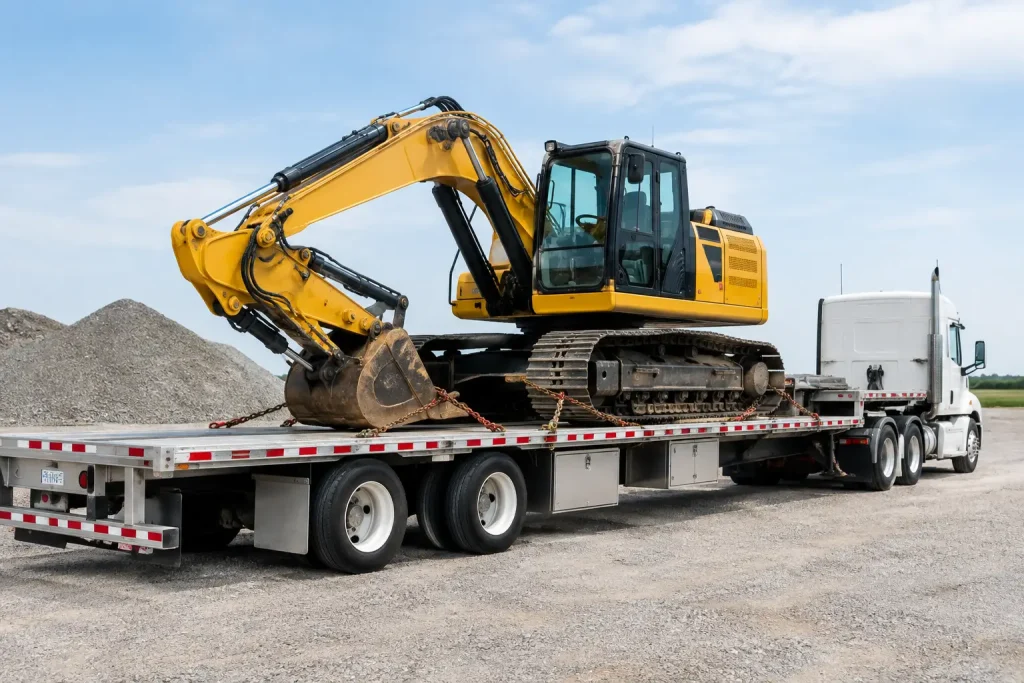
A machine can be ready to move and still miss its scheduled pickup because the trailer cannot safely enter the property, turn around, or reach the loading area. Machinery loading site requirements are not just a final detail for the driver. They affect the equipment quoted, the carrier options available, permit planning, loading safety, and whether a pickup can proceed without delay.
For construction equipment, agricultural machinery, industrial units, and other heavy loads, a useful freight quote starts with the machine’s dimensions and weight. A workable move also requires a realistic picture of both the pickup and delivery sites. The shipper controls that site information; the carrier needs it before dispatch.
Start With Access, Not Just the Machine
A flatbed, step deck, RGN, or lowboy may have very different access needs. The right trailer depends on the machine’s loaded height, width, length, weight, ground clearance, and loading method. But even an appropriate trailer is of little help if it cannot get through the gate or maneuver around parked vehicles, stockpiles, utility poles, or tight corners.
Before requesting transportation, look at the complete route from the public road to the loading point. Do not assume a driveway that handles dump trucks can handle every lowboy or long combination. A trailer’s turning path, low ground clearance, axle configuration, and required approach to a ramp can create limitations that are not obvious from a passenger vehicle.
Confirm the road name, site address, gate location, and any alternate entrance that a commercial vehicle can use. If the equipment is at a large plant, quarry, farm, port-adjacent yard, or construction project, identify the exact loading area rather than relying on the main office address.
Machinery Loading Site Requirements Checklist
The following details give a freight coordinator and prospective carrier a clearer basis for matching the move to suitable equipment. Requirements vary by load, trailer, road authority, and property, so this is a planning checklist rather than a substitute for a carrier’s final site assessment.
- Entrance dimensions and approach: Provide gate width, overhead clearance, driveway width, tight turns, steep grades, and any narrow bridge, culvert, or cattle guard on the route into the site.
- Maneuvering room: Describe whether the truck can pull through, make a wide turn, or needs a place to turn around. Include parked equipment, containers, materials, and other obstacles that may be present on pickup day.
- Surface and ground conditions: Note whether the loading area is paved, compacted gravel, dirt, mud-prone, uneven, or soft after rain. A heavy trailer can damage weak surfaces or become difficult to position safely.
- Overhead and side obstructions: Identify power lines, tree branches, building overhangs, signs, pipe racks, gates, and adjacent structures. Do not estimate clearance from memory if the machine will ride high on the trailer.
- Loading method: State whether the machine will drive onto the trailer, be loaded by crane, forklift, winch, or another method controlled by the loading operator. Confirm that suitable equipment and trained personnel will be available.
- Site rules and timing: Share required appointments, safety orientation, personal protective equipment rules, escort requirements, gate hours, restricted work periods, and the contact who can authorize entry.
Photos complement measured clearances and the carrier’s assessment; they do not replace them. Wide photos from the entrance, along the access road, and around the loading area can show constraints that a written description misses. Include a reference point in photos when possible, and tell the coordinator when images are older than the current site layout.
Confirm the Loading Area and Equipment Condition
The loading area must accommodate more than the machine itself. It needs room for the trailer to align, for the loading operator to work safely, and for the equipment to be positioned without blocking traffic or creating a dangerous slope.
If a machine will drive onto a trailer, the shipper should verify that it is operational, fueled as appropriate for the move, and able to move under its own power. Report nonworking brakes, steering concerns, leaks, damaged tracks or tires, and any condition that affects loading. A non-running machine may require different planning and can limit carrier availability.
For crane or forklift loading, confirm with the site operator or loading contractor who will plan the lift, supply suitable equipment, and provide qualified personnel. A freight broker coordinates transportation with independent carriers; it does not direct the loading crew or provide improvised rigging instructions. Tell the coordinator the planned loading method early, especially for industrial machinery with lift points, unusual centers of gravity, or loose components.
Follow the specific equipment manufacturer’s instructions and the agreed transport preparation plan for loose accessories. Do not remove heavy components without appropriate instructions and support. Buckets, forks, attachments, counterweights, booms, and removable guards can change the dimensions and weight that must be quoted. The carrier also needs to know whether any attachment travels with the machine or ships separately.
Measure the Load as It Will Travel
Measurements should reflect the machinery in transport condition, not a brochure specification or a measurement taken before attachments were installed. Report overall length, width, height, and total weight. For tracked or wheeled equipment, include attachments, extensions, and anything that remains on the machine during transport.
Height is particularly sensitive. Overall loaded height includes the trailer deck, the machine in transport configuration, and any blocking or supports. The carrier must check the actual loaded clearance. An RGN or another low-deck trailer may help with loaded height or loading approach, while other loads may fit a step deck or flatbed. The final equipment choice depends on the complete load and route, not a single measurement.
Oversize dimensions can affect permits, route restrictions, travel windows, escort needs, and carrier selection. State size and weight requirements differ, and a route that works in one state may have different limits in the next. The carrier and permit service must follow the route and conditions approved by the issuing road authority where a permit is required. Give accurate dimensions early rather than hoping a small difference will not matter.
Cargo securement is also regulated. FMCSA cargo securement rules in 49 CFR Part 393 include general requirements and commodity-specific provisions for certain heavy vehicles, equipment, and machinery. The carrier is responsible for securing cargo in compliance with applicable rules, while the shipper should provide accurate weight, configuration, and condition information that affects that work.
Do Not Forget the Delivery Site
Delivery failures often happen because the receiving location was treated as an afterthought. The same machinery loading site requirements apply at delivery: truck access, turnaround space, ground conditions, overhead clearance, unloading equipment, site contacts, and operating hours.
Ask the receiving party whether the machine can be unloaded at the final address. If not, a nearby paved yard, equipment dealer, or other approved staging location may be more practical. This needs to be arranged before dispatch, not after a driver reaches a residential street, congested job site, or soft field entrance.
For construction projects, conditions can change quickly. Rain, excavation, material deliveries, and new barriers can alter site access in a few days. Reconfirm the delivery plan shortly before arrival, particularly for an oversized load or a trailer that requires substantial room to maneuver.
Give the Coordinator a Complete Site Brief
A strong quote request combines machine details with clear loading-site facts. Provide the pickup and delivery ZIP codes, exact dimensions and weight, make and model, operational status, loading method, photos, date range, and site contact information. Mention every known restriction, including low wires, limited gate hours, security procedures, or a need for an appointment.
The shipper’s role is to supply accurate information and prepare the property and machine. The broker’s role is to coordinate the shipment and communicate requirements with independent carriers. The carrier evaluates the equipment, route, and operational conditions before accepting the move, while the loading operator manages the actual loading activity at the site.
Alex Kram’s personal experience driving flatbed and step deck trucks for nearly a million miles on U.S. highways informs Fargo Express’s practical approach: small site details can determine whether a load moves efficiently or becomes a last-minute problem. A clear site brief gives everyone a better starting point.
When you are ready to request an oversized freight quote, send the machine specifications and site photos together. The most helpful question is not simply, “Can this machine be hauled?” It is whether the selected trailer can safely reach, load, and leave both locations under the conditions expected on the day of transport.
Fargo Express is a U.S. freight broker coordinating oversized transportation and interstate ground delivery with independent carriers. Request a machinery shipping quote with the load details and a current site brief for both locations.