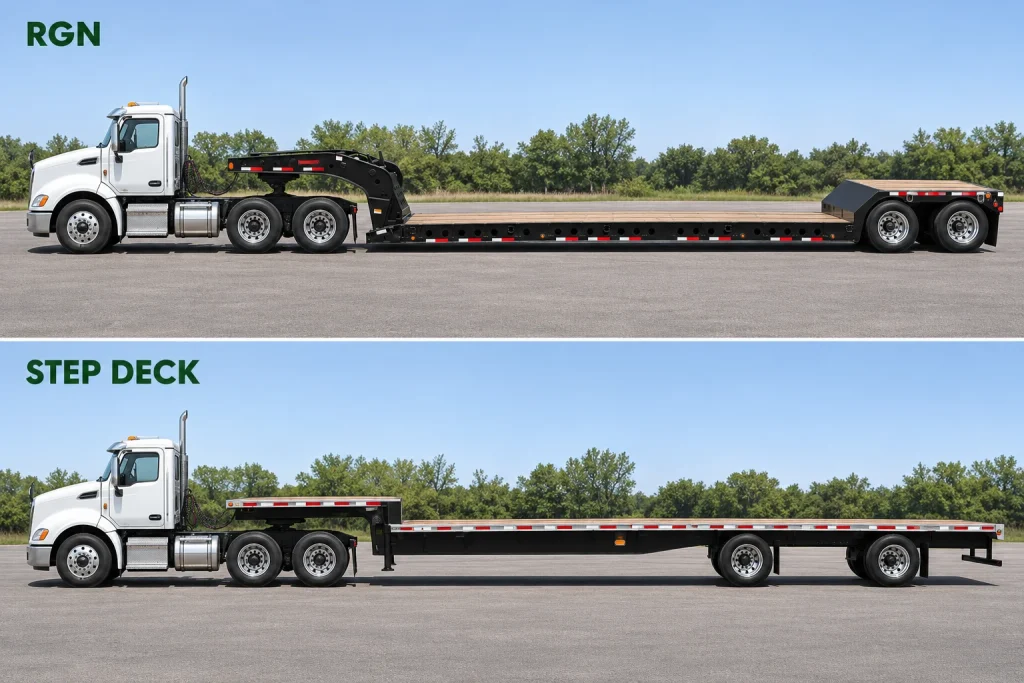
A removable gooseneck versus step deck decision often comes down to one practical question: can the equipment load safely and legally without creating extra handling at either end? A few inches of loaded height, a machine’s ground clearance, or the availability of ramps can change the trailer that makes sense. Choosing by trailer name alone can lead to an unusable quote or delays when the carrier arrives.
For construction equipment, agricultural machines, industrial components, and other open-deck freight, the best option depends on the loaded dimensions, total weight, loading method, route, and site conditions. The lower trailer is not always the better trailer, and the less expensive-looking option is not always the lower-cost shipment after loading requirements and permits are considered.
Removable Gooseneck Versus Step Deck: The Core Difference
A step deck trailer has two deck levels. The upper deck sits behind the tractor, then the trailer drops to a lower main deck after the front step. Depending on the freight and available equipment, a step deck may be loaded by forklift or crane, from a suitable dock, or using carrier-approved ramps.
A removable gooseneck trailer, often called an RGN, has a front section that detaches. Once detached, the trailer deck can be placed close to the ground so wheeled or tracked equipment may be driven onto it from the front. The detachable neck is then reconnected for transport. RGN configurations vary widely, including different well lengths, axle counts, and weight ratings.
The practical distinction is loading geometry. A step deck can work very well for freight that can be lifted onto the deck, loaded from a dock, or driven up suitable ramps. An RGN is often the stronger candidate when a machine needs a lowered front-loading approach, has limited ramp clearance, or is too tall to ride on a standard step deck while remaining within a workable legal or permitted height.
Deck Height Can Change the Entire Plan
A typical step deck main deck is lower than a standard flatbed, but it is still substantially higher than the well of many RGN trailers. Actual deck heights vary by trailer design, suspension, tires, and axle configuration, so a coordinator should confirm the carrier’s equipment rather than rely on a generic measurement.
Manufacturer examples illustrate the difference: the Fontaine Renegade LXN40 drawing shows a low central well, while the Fontaine Infinity brochure shows single-drop step deck configurations. These are examples, not specifications for the trailer assigned to your shipment.
That height difference matters most with tall machinery. Consider a machine that is 10 feet tall in its travel position. On a step deck, the combined load height may approach or exceed height limits for the planned route. On an RGN, the same machine may sit low enough to reduce permit requirements or make a route more feasible. It may still require permits, surveys, route restrictions, or an alternate setup, but the lower deck creates more options.
For a quote, measure the machine to its highest point in the intended shipping configuration. The carrier then confirms the overall loaded height using the assigned trailer and any required supports. Include exhaust stacks, cabs, guardrails, mounted attachments, or any component that cannot be removed. If an attachment will travel separately, provide its dimensions and weight as a separate piece rather than treating it as an afterthought.
Width and length matter just as much. On the National Network and reasonable access routes, cargo extending beyond the federal 102-inch (8-foot-6-inch) width limit requires an overwidth permit, as explained in the FHWA width guidance; Hawaii has a separate allowance. Requirements elsewhere depend on the state and road. A long machine can also create rear overhang or turning issues even if it fits within the trailer’s stated deck length. Carriers need the full loaded dimensions, not only a brochure specification.
When a Step Deck Is the Better Fit
A step deck is often a practical choice when freight needs a lower deck than a flatbed but does not need ground-level loading. Common examples include crated machinery, steel fabrications, generators, palletized industrial freight, and equipment that can be loaded by forklift, crane, dock, or approved ramps.
It can also make sense for drivable equipment when the machine has adequate clearance and both pickup and delivery sites can accommodate the planned loading method. That last condition deserves attention. A jobsite with soft ground, tight turns, parked vehicles, or a narrow entrance may prevent a carrier from safely positioning ramps or unloading where the shipper expected.
Step decks are not one uniform product. A standard step deck, extendable step deck, and step deck with ramps have different useful deck space and loading characteristics. Ask whether the freight must remain on the lower deck, whether it can ride on the upper deck, and whether any portion needs to extend beyond the trailer.
A step deck may also be the more efficient option for a load that is tall but not especially heavy, assuming the total loaded height and loading plan work. For a shipment with no need for a detachable neck, requesting an RGN by default can narrow carrier availability and add cost without solving a real problem.
When an RGN Is Worth Requesting
An RGN is often appropriate for self-propelled machinery or other equipment that needs a shallow front-loading approach. Excavators, pavers, rollers, forestry equipment, larger agricultural machines, and some industrial machines are examples where the loading approach may point toward an RGN.
It is also commonly considered when low ground clearance makes steep ramps impractical. The lower well can reduce the risk that a machine bottoms out during loading, but clearance still has to be evaluated by the carrier and loading operator. Breakover angle, approach angle, attachment position, tire or track condition, and trailer configuration all affect feasibility.
Weight is another reason to consider an RGN, particularly a multi-axle unit. However, an RGN is not automatically the answer for every heavy load. The cargo’s weight, center of gravity, dimensions, contact footprint, and placement help determine the needed configuration. The carrier also checks the loaded tractor and trailer axle weights. A 45,000-pound machine and a 75,000-pound machine may require very different trailer and permit plans even if their overall dimensions look similar.
Specialized RGN equipment may require more lead time than a general step deck, particularly on difficult lanes or when permits and route review are involved. That is a planning factor, not a reason to assume the shipment cannot move. Giving a broker complete information early allows the coordinator to seek suitable independent carriers rather than forcing a last-minute trailer substitution.
Permits, Routing, and Securement Are Not Trailer Details
Trailer selection and oversize compliance are connected, but they are not the same decision. A lower deck may reduce overall height, while a wider or longer load can still trigger permit requirements. State agencies set many oversize and overweight rules, and requirements can change across state lines.
The FMCSA cargo securement rules in 49 CFR Part 393 apply to cargo-carrying commercial motor vehicles operating in interstate commerce, with general and commodity-specific provisions. The carrier is responsible for determining how the freight can be legally and safely secured on the assigned trailer. Shippers should provide accurate weight, dimensions, machine condition, and available tie-down information when requested, but should not assume a generic securement plan fits every load.
Permits may involve route restrictions, travel-hour limits, escort requirements, bridge or structure review, and weather-related limitations. For example, Caltrans permit conditions and accompaniments cover route verification, overhead clearance, weather, curfews, and pilot-car conditions; other states have their own requirements. A carrier or permit service may need the exact origin and destination addresses before confirming a route. A city address is usually not enough for an oversize move because the access roads, entrance, and final placement area can matter.
Information to Provide for a Useful Quote
The most useful quote request explains the shipment as it will actually travel. For an RGN or step deck evaluation, provide the pickup and delivery addresses, ready date, and whether dates are flexible. Include the equipment make and model when available, along with verified length, width, height, and total weight.
Also identify whether the machine runs, rolls, steers, and brakes normally. Describe attachments, loose accessories, counterweights, and parts that ship separately. Photos from all sides are helpful, especially photos showing tracks or tires, low-clearance areas, and the proposed pickup location.
Site information is equally valuable. State whether loading will be done by driving on, forklift, crane, dock, or another planned method. Mention overhead lines, gates, mud, steep grades, restricted access, or jobsite rules. The shipper or site contact should confirm who will operate the equipment during loading and unloading and whether that person will be present.
A freight broker coordinates the shipment and communicates the load requirements to independent carriers. The carrier evaluates trailer suitability, loading feasibility, routing, permits, and securement for the specific move. Clear information at the quote stage helps all parties identify issues before a truck is dispatched.
For a removable gooseneck versus step deck shipment, start with the machine’s actual travel dimensions and how it can be loaded, then let those facts guide the equipment request. A well-prepared quote request gives the carrier a better chance to match the right trailer to the job rather than asking the load to fit the trailer that happens to be available.
Fargo Express coordinates U.S. freight through independent carriers. Explore Oversized Transportation for equipment and out-of-gauge loads, or Interstate Ground Delivery for other domestic freight. Request a freight quote with the machine details and site information above so the loading plan and trailer requirements can be reviewed.