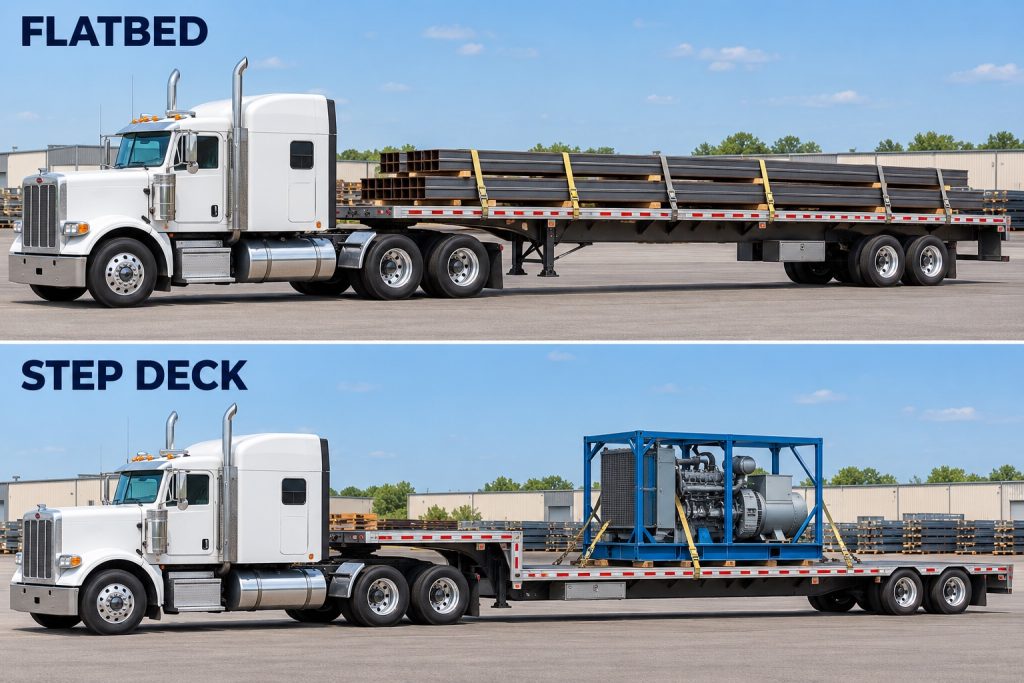
A load can be within legal width and weight yet still be wrong for a standard flatbed. The deciding measurement is often height from the ground, not the overall footprint. In a flatbed vs step deck trailer decision, a few inches can determine whether machinery moves as a routine open-deck shipment or requires oversize permits, route review, and a different trailer.
For commercial shippers, the right choice starts with complete dimensions, actual shipping weight, loading method, and pickup and delivery conditions. A trailer is not simply a platform with enough room. Its deck height, ramp access, axle configuration, and available securement points affect whether a carrier can safely and legally handle the freight.
The basic difference between a flatbed and step deck trailer
A standard flatbed trailer has one continuous deck. It works well for freight loaded by forklift or crane, or from a compatible dock after the loading arrangement is confirmed. Common examples include bundled steel, building materials, palletized industrial freight, crated components, and equipment that stays within legal height on the selected trailer.
A step deck, also called a drop-deck trailer, has an upper deck over the tractor and a lower main deck behind it. That lower position provides more vertical clearance than a taller deck and may avoid the need for an RGN or lowboy, depending on the load.
Dimensions vary by model. For example, the manufacturer’s Kalyn Siebert Step Deck Extendable specification sheet lists a 10-foot upper deck, a 43-foot lower deck when closed, a 40-inch loaded lower-deck height, and a 60-inch upper-deck height. These are specifications for that model, not universal step-deck dimensions. Confirm the actual trailer, usable deck length, capacity, and loaded deck height before committing the shipment.
When a standard flatbed is the better fit
A flatbed is often the practical choice when the load is low enough, can be loaded from the side or above, and does not need ramps. It is a common equipment type, which can make carrier sourcing more straightforward in many lanes.
Flatbeds also provide a single uninterrupted deck. That matters when long freight needs consistent support along its length or when the cargo cannot bridge the transition between an upper and lower deck. Long structural components, fabricated assemblies, and certain machinery skids may sit more naturally on a flatbed.
A flatbed may be appropriate when the shipment is:
- Within applicable height limits after accounting for the actual loaded deck height and any blocking
- Loaded by crane, forklift, or dock rather than driven onto the trailer
- Long enough that a continuous deck provides better support
- Compatible with standard open-deck securement planning
- Picked up or delivered at sites with sufficient overhead and side access
There is no single federal vehicle-height limit. According to FHWA guidance on vehicle size and weight, states set their own height limits, typically from 13 feet 6 inches to 14 feet. Route-specific restrictions and overhead clearances still need review. A 10-foot-tall load may fit within a height limit on a lower step deck yet exceed it on a taller flatbed. Check the complete loaded height and every part of the route, including local access roads.
When a step deck trailer makes more sense
The principal advantage of a step deck is lower deck height. It is frequently used for tall machinery, agricultural equipment, construction attachments, tanks, and industrial units that are too tall for a flatbed but do not require the very low well of an RGN or lowboy.
Step decks can also be available with ramps, allowing certain self-propelled equipment to be driven onto the trailer. Ramp availability is not automatic, and ramp angle, ramp capacity, ground conditions, and equipment clearance all need review. A machine with low ground clearance may not safely transition onto a standard step deck even if its weight is acceptable.
The trade-off is deck geometry. The lower deck is shorter than a flatbed’s full deck, and the upper deck creates a height transition. Freight that is long, fragile, unusually shaped, or built on a wide skid may require more careful placement. A step deck may also have fewer workable loading positions for large pieces of machinery.
A simple height example
Suppose a machine measures 10 feet 2 inches in its shipping configuration. Using an illustrative 60-inch flatbed deck, the combined height would be 15 feet 2 inches before any blocking. With a 40-inch lower deck, as in the manufacturer example above, it would be 13 feet 6 inches before blocking.
The lower-deck example reaches a common state threshold with no allowance for blocking or measurement differences; it does not establish that the load can travel legally or clear the route. A lower trailer, a different shipping configuration, or permits may still be needed. The carrier must verify the actual loaded height, trailer configuration, applicable limits, and route clearances.
Dimensions are only the first screening step
Height gets attention, but length, width, weight distribution, and loading method can change the answer. A step deck does not automatically solve an oversized shipment. A wide machine can still need permits. A heavy item can require a different axle arrangement. A load with unusual center of gravity may need a trailer configuration that accommodates safe weight distribution and securement.
Before requesting a quote, gather the information that lets a freight broker and carrier evaluate the shipment accurately:
- Overall length, width, and height in its shipping configuration
- Actual weight, including installed attachments, fluids, and accessories
- Photos from all sides, plus photos of lifting points, tires, tracks, or skids
- Whether the equipment rolls, drives, lifts by crane, or requires a forklift
- Pickup and delivery addresses, site hours, and contact information
- Access constraints such as gates, soft ground, overhead lines, or tight turns
If an attachment can be removed and shipped separately, state that early. Reducing height or width may change the trailer type, permit needs, and available carrier options. The shipper or equipment owner should confirm what can be removed and whether the machine can travel safely in that configuration.
Loading and unloading can decide the trailer
A trailer that fits the freight on paper may fail at the jobsite. Flatbeds often suit crane-loaded or forklift-loaded freight. Step decks with ramps may suit wheeled or tracked equipment, but the site must have firm, level enough ground and adequate approach space.
The carrier is responsible for operating its equipment and following applicable transportation requirements. The shipper or loading operator is typically responsible for providing accurate load information and suitable loading conditions. A freight broker coordinates the shipment plan and communicates requirements, but does not replace the people operating cranes, forklifts, or equipment at the site.
For machinery shipments, confirm who will load, who will unload, and whether each party has the capacity to do so. Clarify whether the equipment runs, whether it has brakes and steering, and whether it will be loaded under its own power. These details affect carrier selection and scheduling.
Permits, routes, and cargo securement
If the loaded dimensions or weight exceed legal limits, permits may be required from the states on the route. Permit rules, escort requirements, travel-hour restrictions, and routing limits are state-specific. A permitted load also may need a different route than a legal-size shipment because of bridges, low clearances, construction zones, or local restrictions.
Cargo securement is not an afterthought. FMCSA cargo securement rules appear in 49 CFR Part 393, Subpart I, with additional commodity-specific requirements for certain equipment and materials. Carriers must determine and apply the securement method required for the load. Shippers should provide accurate weight, dimensions, condition details, and accessible securement information rather than assuming one method fits every machine.
Do not rely on a trailer category alone to determine compliance. A step deck can reduce loaded height, but permits may still be necessary for width, length, axle weights, or route conditions.
How to choose without overbuying equipment
Start with a standard flatbed when the freight fits legal height, has a practical loading method, and benefits from a continuous deck. Move to a step deck when height is the limiting factor or ramps are genuinely needed. If the item remains too tall, too heavy, or difficult to load on a step deck, an RGN, lowboy, multi-axle trailer, or another specialized configuration may be more appropriate.
The most useful quote request is not simply “need a flatbed.” It describes the freight and lets the transportation team recommend equipment based on facts. Fargo Express can help commercial shippers coordinate open-deck transportation by reviewing those details with available independent carriers and identifying questions before dispatch.
A few accurate measurements, current photos, and an honest description of site conditions usually do more to protect a shipment plan than selecting a trailer name at the start. Get those details together before the equipment is ready to move, especially when a tall or heavy load leaves little margin for error.
For commercial freight moving across the United States, explore our Interstate Ground Delivery service. Ready to review a specific load? Request an open-deck shipping quote with the dimensions, shipping weight, locations, and loading details.