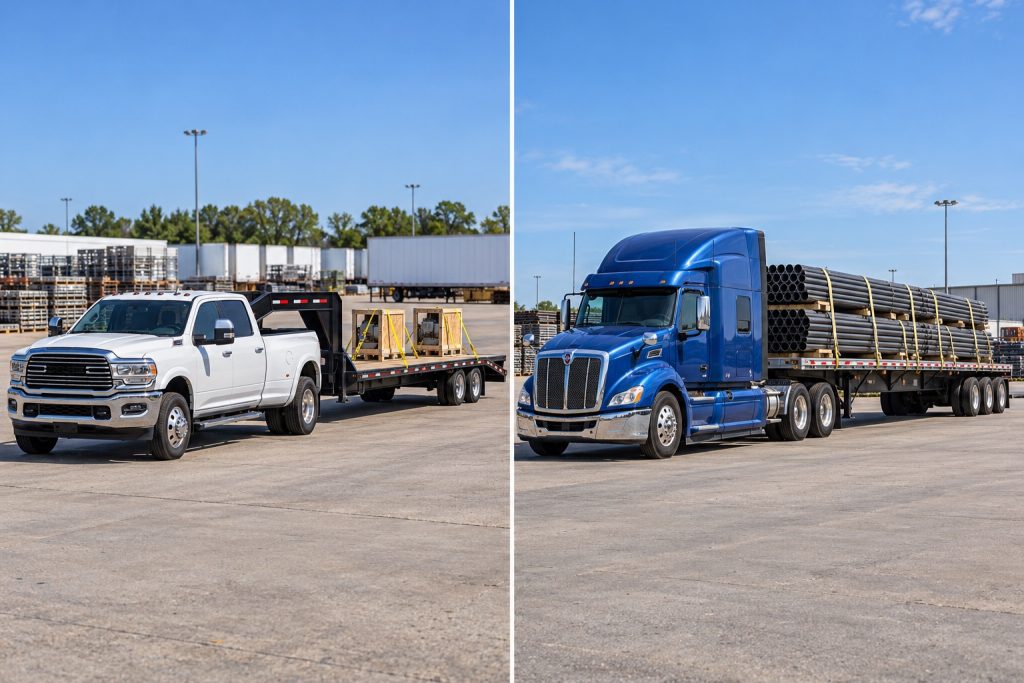
A compact equipment attachment on a regional route does not create the same transportation plan as a large excavator headed across several states. That is the practical difference behind hotshot vs flatbed transport. Both can serve commercial freight, machinery, and construction equipment, but they operate in very different size, capacity, routing, and scheduling ranges.
Choosing the wrong option can mean a truck arrives without enough deck space, insufficient payload capacity, or a trailer that does not match the loading method at your site. The right choice starts with the actual shipment details, not just a general description of the equipment.
What Is the Difference Between Hotshot and Flatbed Transport?
Hotshot transport usually uses a heavy-duty pickup truck pulling a gooseneck trailer. It is commonly used for smaller, time-sensitive, or regional open-deck loads. A hotshot setup may be a good fit when the freight can be loaded safely onto the available trailer, stays within legal weight and dimension limits, and does not require a specialized heavy-haul trailer.
Conventional flatbed transport generally uses a commercial tractor-trailer with a level, open deck. Usable deck space and payload vary with the actual trailer, truck, axle configuration, and route. When the load needs a lower deck or a different loading method, other open-deck options include step decks, double drops, and RGN or lowboy trailers when freight height, weight, or loading requirements call for them.
These are different trailer configurations within open-deck transportation, rather than interchangeable names for the same equipment. A coordinator needs to match the shipment with the actual trailer, available payload, route, and loading conditions.
When Hotshot Makes Sense
Hotshot transportation is often considered for lighter equipment, crated machinery, attachments, steel components, jobsite materials, and auction purchases that need a relatively quick move. It can be especially useful for regional freight where a conventional tractor-trailer would be more equipment than the shipment requires.
Its main advantage is flexibility for appropriately sized freight. A hotshot carrier may be able to respond to a smaller shipment without waiting to build a full truckload plan. That does not automatically make it the least expensive option. Available capacity, pickup location, delivery location, shipment urgency, and deadhead miles all affect the quote.
Hotshot is not a shortcut around weight rules, securement requirements, or permits. A pickup-and-gooseneck combination still has to operate legally and safely, and the carrier must have the proper authority, equipment, and qualifications for the work.
When a Conventional Flatbed Is the Better Choice
A standard flatbed is usually the more practical choice for freight that is longer, heavier, or better suited to a full-size commercial trailer. Common examples include industrial machinery, bundled building materials, structural components, larger agricultural equipment, and construction equipment that can be loaded onto the selected deck with suitable site equipment or a verified ramp arrangement.
A flatbed also provides more room to plan cargo placement. That matters when weight distribution, axle limits, loading order, or multiple pieces must be considered. For a shipper with a full trailer load, a conventional flatbed can be more efficient than trying to divide freight across several smaller moves.
If the loaded combination would exceed applicable height limits, the site needs ramp or front loading, or the equipment requires a lower deck, the answer may not be hotshot or standard flatbed. A step deck, double drop, or RGN may be the better trailer. Asking for “a flatbed” without dimensions can delay that decision.
Hotshot vs Flatbed Transport: The Decision Factors That Matter
The most useful comparison is not speed versus size. It is whether the proposed equipment can legally carry, load, secure, and deliver the shipment along the planned route.
Dimensions and Weight
Start with the freight itself. Measure overall length, width, height, and weight in its shipping condition. Include tracks, buckets, booms, attachments, cradles, skids, and anything that extends beyond the main body of the equipment.
Do not rely solely on a model number or a brochure specification. A machine may have an added attachment, protective structure, tire configuration, or accessory that changes its transport dimensions. For equipment that is not operational, also identify whether it can be winched, forklift-loaded, crane-loaded, or requires a different loading approach.
A hotshot trailer may have less deck length and payload capacity than a commercial flatbed. Meanwhile, a standard flatbed may not provide enough deck height reduction for a tall machine. Weight, dimensions, and center of gravity must be evaluated together.
Loading and Unloading Conditions
Loading conditions often decide the trailer before the highway route does. A loading dock, forklift, overhead crane, loading ramps, and drive-on access each point toward different equipment options.
Confirm who will load and unload the freight. The shipper, consignee, carrier, and site operator may each have separate responsibilities. A freight broker coordinates the transportation plan with an independent carrier, but the loading operator must have suitable equipment and a safe area to perform the work.
Share jobsite details early. Narrow gates, soft ground, tight turns, low tree branches, restricted hours, and limited staging space can all affect whether a full-size tractor-trailer can access the location. A smaller hotshot combination may be easier to position at some sites, but that advantage does not solve an oversized or overweight shipment.
Timing, Distance, and Capacity
Hotshot service is frequently requested when a shipment is urgent. That can be reasonable for a smaller load, but availability still depends on where qualified carriers are positioned and whether the shipment can be moved within applicable hours-of-service rules.
For planned equipment moves and larger loads, a flatbed or specialized open-deck carrier may offer a broader pool of suitable capacity. The earlier the shipment is planned, the more time there is to verify trailer fit, site requirements, permits, and routing.
Avoid assuming that a smaller truck will always arrive sooner or that a bigger trailer will always cost more. Freight markets are local and constantly changing. A useful quote compares the actual transportation requirement, not just the label applied to the truck.
Freight That Commonly Fits Each Option
The following examples are starting points, not equipment recommendations. Actual dimensions, weights, and loading needs must be confirmed for every shipment.
- Hotshot candidates: smaller attachments, compact equipment, light machinery, palletized industrial components, and time-sensitive regional freight.
- Standard flatbed candidates: longer machinery, building materials, fabricated steel, larger equipment, and multi-piece loads that need more deck space.
- Step deck candidates: freight that is too tall for a standard flatbed but does not require a lowboy.
- RGN or lowboy candidates: heavier or taller equipment that needs a lower deck, specialized loading, or more capacity than conventional open-deck equipment can provide.
A shipment can move from one category to another based on a single detail. For example, a removable attachment may change overall length, while a non-running machine may require a trailer with ramps or detachable capability.
What to Provide When Requesting a Quote
A complete shipment description gives a coordinator a better chance of finding the right carrier and avoiding a last-minute equipment mismatch. Gather these details before requesting pricing:
- Pickup and delivery city, state, ZIP code, and any site-access limitations.
- Ready date, delivery deadline if one exists, and receiving hours.
- Exact length, width, height, and verified weight of each piece.
- Make, model, serial number when available, and photos from multiple angles.
- Whether the freight runs, drives, rolls, is forklift-ready, or needs crane or winch loading.
- Loading and unloading equipment available at both locations.
- Any known permit needs, escort requirements, route restrictions, or construction-site rules.
Photos are particularly valuable for equipment with protrusions, unusual geometry, damaged tires, loose parts, or attachments. They help identify whether a standard deck, step deck, or specialized trailer should be considered before a carrier is dispatched.
Route, Permits, and Securement Are Not Afterthoughts
Loads that exceed applicable legal width, height, length, axle-weight, or gross-weight limits may require permits and route review. The FHWA size-and-weight guidance explains the federal scope and the role of state authorities; there is no single nationwide height limit for every route. Permit rules vary by state, and some routes have restrictions based on bridges, low clearances, road construction, travel times, or local regulations. A load that is legal in one state may require a permit or different routing in the next.
Cargo securement is also regulated. For interstate commercial transportation, the FMCSA cargo securement rules include general requirements in 49 CFR Part 393, Subpart I, with commodity-specific provisions for certain equipment and materials. The carrier is responsible for complying with applicable securement rules, while accurate freight information from the shipper supports sound planning.
Do not make assumptions about tarping, chains, binders, attachment removal, or how a machine will be secured. Confirm the freight condition and trailer plan with the carrier before pickup. If an item needs special handling, state that requirement clearly in the quote request.
For commercial shippers comparing hotshot and flatbed options, the best choice is usually the one that fits the freight without forcing compromises on capacity, loading, route legality, or site access. Fargo Express can help coordinate that discussion with independent carriers when you provide complete shipment details. A well-measured load and an honest description of the pickup and delivery sites give everyone a stronger place to start.
Discuss Your Open-Deck Shipment
For interstate ground delivery, share the dimensions, verified shipping weight, route, and loading details. Fargo Express coordinates with independent carriers to review a suitable transport option. For larger equipment, see our Oversized Transportation service and oversize permit planning guide.
Request a freight quote with your pickup and delivery details.