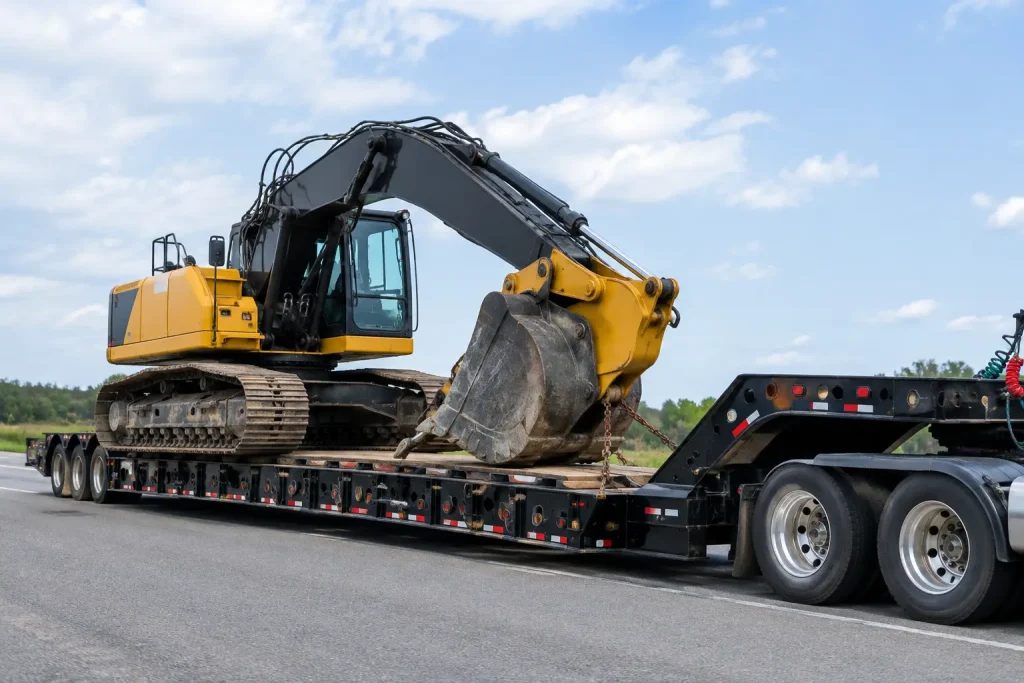
An excavator may look like a routine construction shipment, but small details can change the entire transportation plan. The answer to how to ship an excavator starts with its true transport dimensions, confirmed shipping weight, attachments, and the conditions at both job sites. A machine that fits a standard flatbed on paper may need a lowboy because of height, loading access, or an attachment that cannot travel installed.
For commercial shippers, the goal is not simply finding a truck. It is matching the excavator, trailer, route, loading plan, and permit requirements before a carrier is dispatched.
This excavator-specific guide focuses on boom, stick, track and attachment details. For the broader preparation process, see our heavy-equipment shipping guide.
Start With the Excavator’s Transport Specifications
Do not rely only on the model name or a sales brochure. Excavators within the same model family can have different booms, track widths, counterweights, buckets, guards, and auxiliary equipment. The carrier and freight coordinator need the measurements of the machine as it will actually be transported.
Collect the excavator’s overall transport length, width and height, plus its confirmed shipping weight in pounds. Measure the full outer envelope in the transport position specified by the manufacturer, including the tracks, counterweight, boom, stick and every installed attachment. Include any bucket, thumb, hydraulic hammer, coupler, blade or cab guard that travels with the machine. Have a qualified operator establish the transport position; do not lower or reposition components simply to obtain a smaller quoted height.
Also confirm whether the unit is tracked or wheeled, whether it operates properly, and whether it can be loaded under its own power. A non-running excavator can still move, but the loading method and carrier equipment must be planned in advance.
Useful shipment information includes:
- Year, make, model, and serial number
- Overall length, width, height, and weight
- Attachment type, dimensions, and whether it can ship separately
- Condition of tracks, brakes, hydraulics, and engine operation
- Pickup and delivery addresses, including site contacts and hours
- Photos showing all sides of the machine and the loading area
Photos often reveal issues that dimensions alone do not: a tall cab, a long boom position, muddy access, a tight gate, or a bucket that will need separate handling.
Choose the Trailer for the Excavator, Not the Other Way Around
The right trailer depends on more than weight capacity. Deck height, loading method, axle configuration, and route restrictions all matter.
Flatbed and Step Deck Options
A standard flatbed can work for smaller excavators that stay within legal height and can be safely loaded from a ramp, dock, or suitable site. It is often a practical option when the machine is compact, the route is straightforward, and both locations have room for the truck to maneuver.
A step deck provides a lower main deck than a standard flatbed. That added clearance can help when overall height is close to a legal limit. However, a step deck still requires a workable loading solution, and its deck length and weight distribution must fit the specific machine.
RGN and Lowboy Options
For larger excavators, a lowboy may provide the deck height and configuration the shipment needs. A removable-gooseneck (RGN) lowboy has a detachable neck for front loading; other lowboy designs use different loading arrangements. The carrier must confirm the actual trailer’s loading method and suitability. ROGERS’ detachable-gooseneck example illustrates this specific front-loading design.
An RGN is not automatically necessary for every large excavator. It may be more equipment than a smaller shipment needs, and availability, permit requirements, and loading conditions can affect the decision. Conversely, choosing a higher-deck trailer to save money can create a height or loading problem that costs more later.
A qualified carrier determines whether the trailer has the capacity, axle arrangement, and deck space for the excavator. The freight broker coordinates the shipment details and carrier match. The shipper is responsible for providing accurate equipment and site information, while the loading operator is responsible for safely loading the machine at the site.
Plan Attachments and Transport Position Early
Buckets, breakers, thumbs, grapples, and couplers can affect both dimensions and securement planning. A wide bucket may create an overwidth shipment even if the excavator tracks are within legal width. A long boom position can add length or create a clearance issue near the trailer’s neck.
Ask the equipment manager or qualified operator to follow the model-specific Operation & Maintenance Manual when establishing the boom, stick and attachment transport position. Bobcat’s compact-excavator guidance, for example, directs operators to the machine’s manual for loading and tie-down locations. Confirm whether an attachment should travel separately. Separate shipment is not always required, but it can be the cleaner option when an attachment makes the load too wide, tall, long, or difficult to place safely.
Do not assume a carrier can modify the machine or remove components on site. If disassembly is needed, arrange for a qualified equipment professional and confirm who will handle the work before the truck arrives.
Verify Pickup and Delivery Site Access
A properly selected trailer cannot solve a site-access problem. Before scheduling, review the entrance, surface conditions, turning area, overhead clearance, and space for the driver to position the trailer.
An RGN tractor-trailer needs considerably more room than the excavator itself. Narrow jobsite roads, soft shoulders, low utility lines, parked equipment, sharp turns, and steep grades can all affect whether loading can happen at the stated address. In some cases, a nearby staging yard or a different entrance is the more practical plan.
Confirm who will meet the driver, who can authorize entry, and who will operate the excavator. The site should have a clear loading area free of unrelated traffic and personnel. If pickup or delivery is at an auction yard, dealer lot, mine, or active project, ask about appointment rules, required personal protective equipment, and any release documents needed before loading.
Account for Oversize Permits and Route Limits
FHWA’s size-and-weight guidance explains the general 102-inch (8-foot-6-inch) width framework for commercial vehicles and cargo on the National Network. Overall loaded height, length, gross weight, axle weights and the specific route also matter. State and local permit requirements can differ; cargo measurements alone do not establish whether the complete vehicle and load can travel legally.
For oversized excavator shipments, the carrier or its permit service obtains permits for the approved route. The route may include restrictions such as travel hours, holiday limitations, escort requirements, bridge limits, or roads that cannot accommodate the permitted dimensions. Permit timing should be considered before promising a pickup date to a customer or project manager. California’s single-trip permit guidance, for example, describes route-dependent limits and permit conditions.
Cargo securement is also regulated. FMCSA cargo securement rules include general and commodity-specific provisions in 49 CFR Part 393, Subpart I. Section 393.130 addresses wheeled or tracked heavy equipment weighing 10,000 pounds or more; lighter equipment also needs securement under an applicable rule. The carrier is responsible for determining and applying compliant securement methods. The shipper should provide correct weight, dimensions, and equipment condition so the carrier can make that determination.
Request a Quote With the Details That Matter
A useful freight quote should reflect the actual excavation equipment and transport conditions, not a guessed weight and a pair of ZIP codes. If measurements are uncertain, say so and provide photos or manufacturer specifications for review. Incorrect information can lead to a truck that cannot load the machine, a permit revision, or a delay at pickup.
When requesting a quote, provide the ready date, addresses, machine details, attachment information, loading method, site contacts, and any time restrictions. Tell the coordinator whether the excavator is running and whether there are cranes, ramps, or operators available. If timing is sensitive, explain why, but allow room for carrier scheduling, permits, weather, and route conditions.
Fargo Express is a freight broker coordinating interstate ground delivery and oversized transportation with independent carriers. We review the shipment details to help match the excavator with a suitable carrier and trailer. Alex Kram’s background includes more than 20 years in transportation logistics and nearly a million miles driving flatbed and step deck trucks in the United States, experience that informs a practical view of loading access and trailer selection.
On Shipping Day, Keep Communication Simple
Have the excavator ready at the agreed time, with the site contact reachable by phone. The operator should be prepared to load only when directed by the carrier and within site safety procedures. Keep final dimensions, equipment photos, release paperwork, and destination contact information available in case the driver or coordinator needs to confirm a detail.
At delivery, inspect the excavator before it leaves the site and note any visible issues through the proper receiving process. A clear handoff matters just as much as a clean pickup, especially when the machine is headed directly to an active project.
The best excavator shipment is usually the one planned early enough to avoid last-minute trailer changes, access surprises, and permit corrections. Accurate information gives the carrier a safer, more realistic way to move the machine where it needs to work.
Request an excavator shipping quote with your machine configuration, pickup and delivery details, photos and shipment readiness. Our quote-information checklist helps organize the request.